
Freedom, Truth, and the Human Person in the Age of Artificial Intelligence
A Roundtable Conversation with Bishop Maxim at St. Archangel Michael Serbian Church, Saratoga
In the social hall of St. Archangel Michael Serbian Church in Saratoga, a rare and timely conversation unfolded. Bishop Maxim sat at the center of a roundtable that gathered engineers, IT professionals, professors, scientists, and theologians—men and women whose daily work shapes the technological systems increasingly governing contemporary life. What emerged was not a technical workshop, nor a polemical critique of artificial intelligence, but a searching dialogue about truth, freedom, human personhood, and communion in an age increasingly mediated by algorithms.
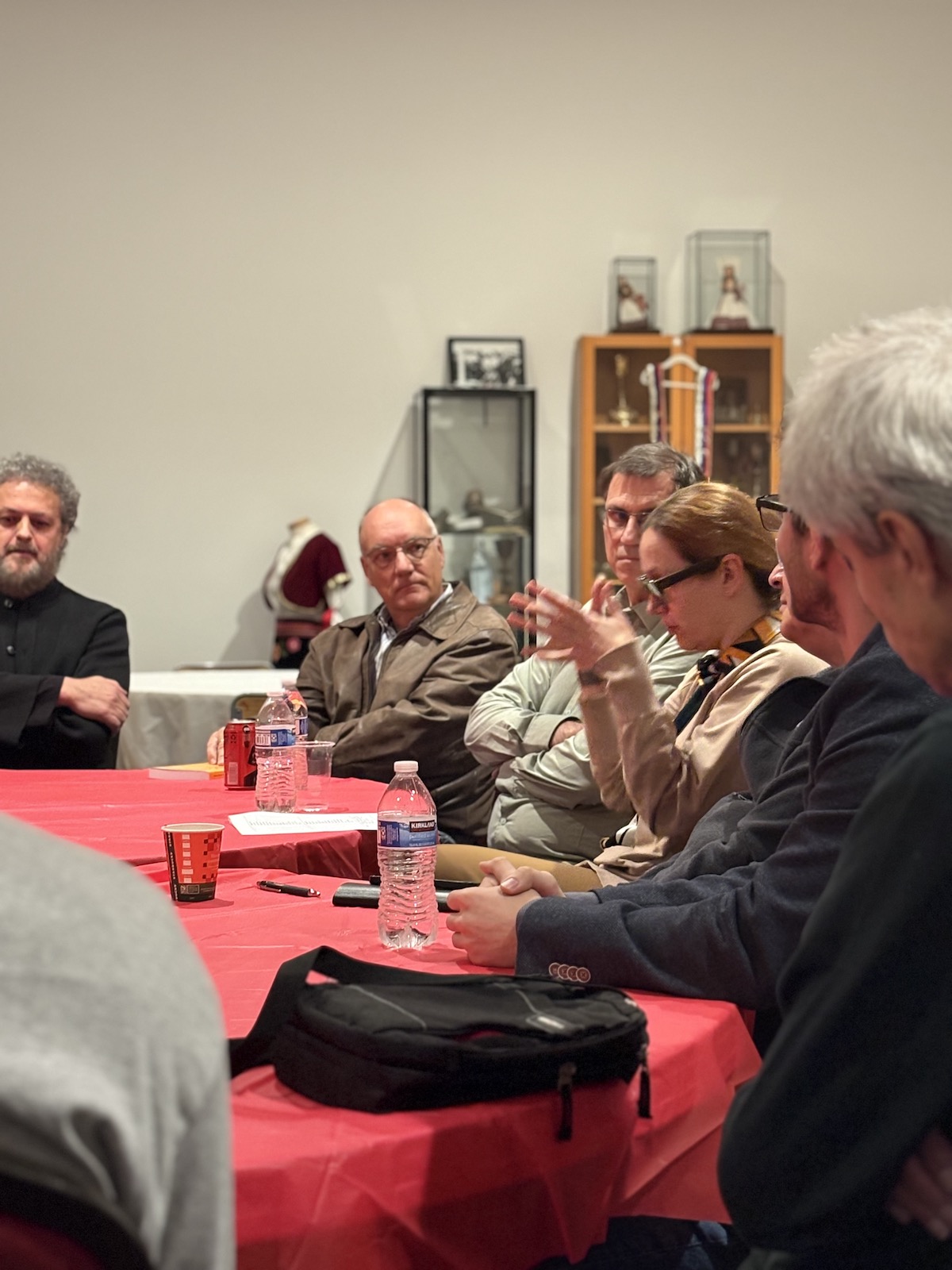 Over the last two years, participants noted, AI systems have become “unapologetic.” They no longer present themselves as experimental tools but as authoritative infrastructures. We trust them so deeply that we are now willing to give them access to our finances, our schedules, our medical data—perhaps soon even our bank accounts. AI has become, as one participant evocatively described it, a mirror book: a vast reflective surface that shows us ourselves yet often distorts what it reflects.
At the heart of the discussion stood the question of truth. As Professor Zečević emphasized, truth remains essential—even non-negotiable. AI systems, however, do not “care” about truth in a human sense. They care about statistical likelihood, correlation, and pattern recognition. Their immense memory and capacity to track behavior create the illusion that they know us personally. Yet this illusion carries dangers. When systems simulate understanding without lived experience, participants warned, the result can resemble a kind of “AI psychosis”—a feedback loop where meaning collapses into probability.
This raised deeper concerns about language and consciousness. AI operates within theories of language that treat words as data points rather than lived symbols. It can generate coherent text, even emotionally resonant responses, but it does so without emotions, instincts, or embodied intelligence. Several speakers pointed to emerging “agent personas”—AI simulations trained on real individuals, already being deployed by startups because they are cheaper, tireless, and obedient. Stanford experiments simulating human communities were mentioned as a sign of how far such technologies have advanced.
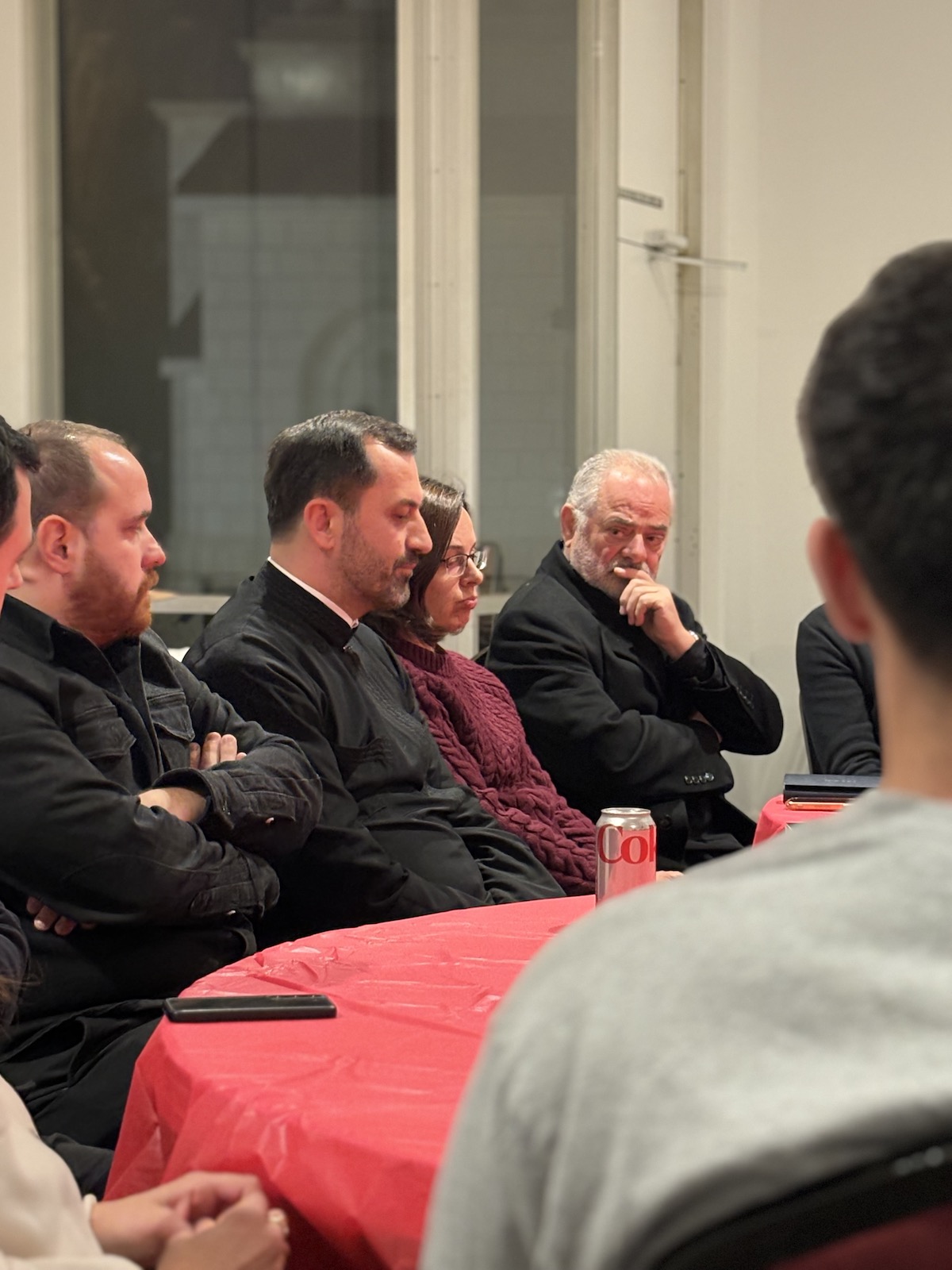 Yet here chaos theory entered the conversation. The butterfly effect—small changes producing vast consequences—suggests that systems built on predictability will eventually encounter breakdown. Human emotion, instinct, contradiction, and freedom resist full formalization. As one participant noted, invoking what is often called Descartes’ error, emotions are not a defect in human reasoning; they are essential to it.
Bishop Maxim returned repeatedly to the theme of freedom. The human person, he noted, is uniquely capable of rejecting both good and evil. God does not desire mere obedience but free response. Freedom is not an obstacle to perfection; it is its condition. Any system—technological or social—that eliminates freedom in the name of efficiency ultimately undermines what it means to be human.
This insight led to a striking question: If AI can do everything up to the point of problem-solving, who will ask the next questions? Machines can assimilate data, follow tasks, and optimize solutions—but they do not generate meaning. They do not suffer, hope, repent, or love. Theology, several participants observed, has a unique capacity to reconcile contradictions rather than eliminate them. Where AI seeks coherence, theology holds paradox—divinity and humanity, freedom and obedience, death and resurrection—without collapse.
The conversation also addressed governance and creativity. AI can free human beings from repetitive labor, allowing space for creativity, contemplation, and relational depth. But this depends on how tools are used. The guiding question emerged clearly: How can AI augment human life without replacing the human person?
Examples from medicine illustrated the limits of pure protocol. Only about 33% of doctors strictly follow standardized heart disease guidelines—not because they are ignorant, but because they treat particular persons. A doctor reads body language, tone, hesitation, fear—signals no algorithm fully captures. This distinction between information and formation became crucial. Information can be processed; formation occurs only in relationship.
The Church’s role in this landscape was a recurring concern. The Church, participants reflected, is not an institution alone but an interaction of persons. In the premodern era, togetherness was assumed; in the modern era, individual rights came to the forefront; in the postmodern era, we face fragmentation and suspicion of grand narratives. The question now is whether we can live with AI and still love the other—or whether we will attempt to exist without the human being.
True communion, Bishop Maxim stressed, cannot be imposed. It must be freely entered. Yet where such communion exists, it can become the most prosperous and life-giving reality imaginable. This raised even eschatological questions: What does it mean to say “death is trampled down by death” in an age that seeks digital immortality? Is AI humanity’s “last exam”—in universities, professions, and the wider world?
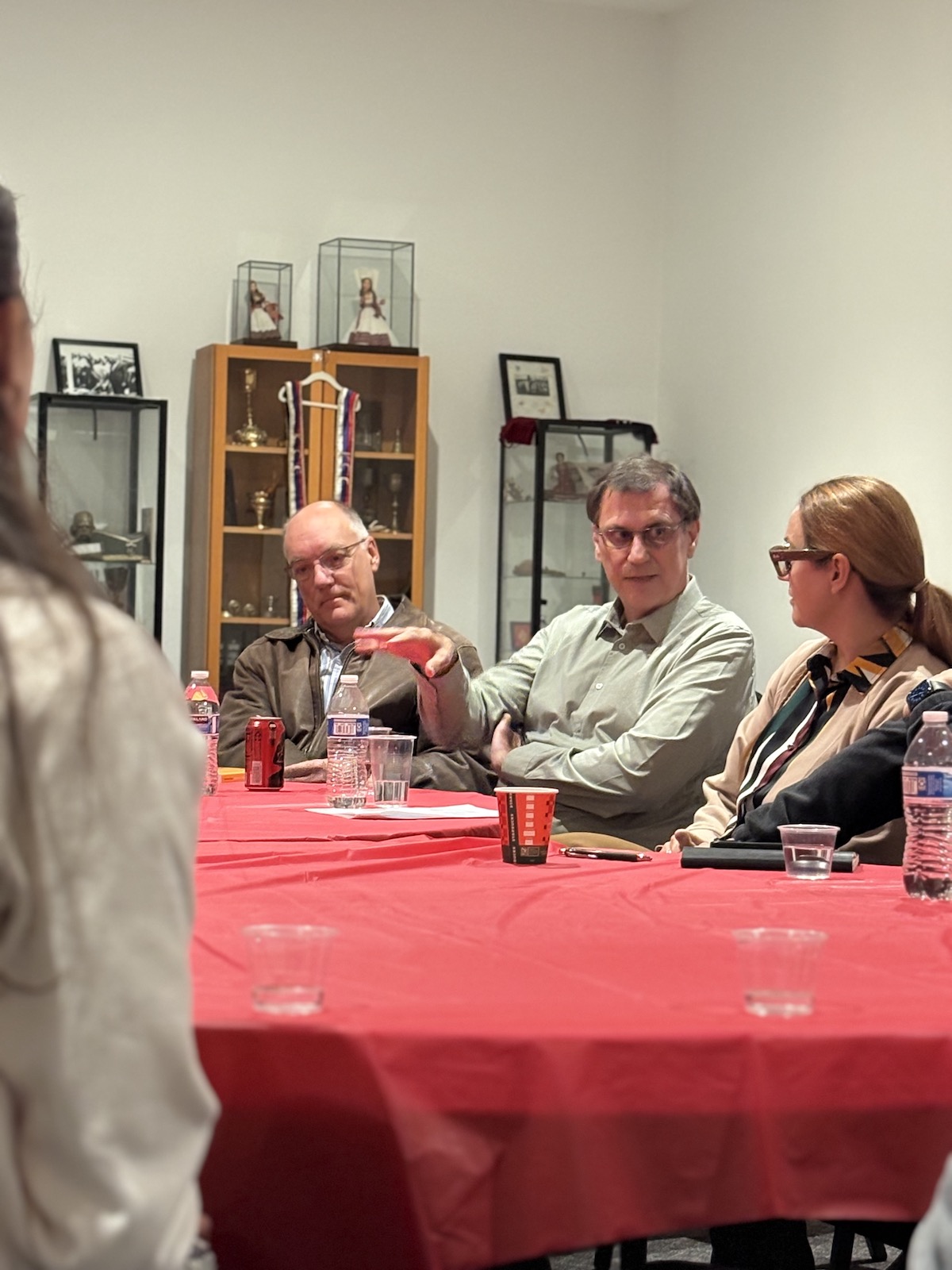 Drawing on Metropolitan John Zizioulas, participants distinguished ethos—what one grows up with—from ethics—what one learns. AI can be trained in ethics, but ethos is formed in lived communion. This distinction cuts to the heart of the theological question: AI may reflect aspects of human intelligence, but it does not bear the image of God. And yet, as one participant provocatively asked, what part of me is already a machine?
The evening concluded not with answers but with humility. Physics itself teaches humility: the more we know, the more mystery remains. The early Church, participants recalled, did not disclose everything at once; it preserved sacred mystery. Knowledge alone is not salvific. True learning happens in relationships—between persons, and ultimately, between humanity and God.
What lingered after the roundtable was a shared conviction: technology will continue to evolve, but the human vocation remains the same—to seek truth, to exercise freedom, to love the other, and to enter into communion that no machine can replace.
Hieromonk Basil Gavrilovic
ChatGPT (Open AI) was used for initial brainstorming
of topic ideas and for refining the
grammar and flow of this text


